Position in poker
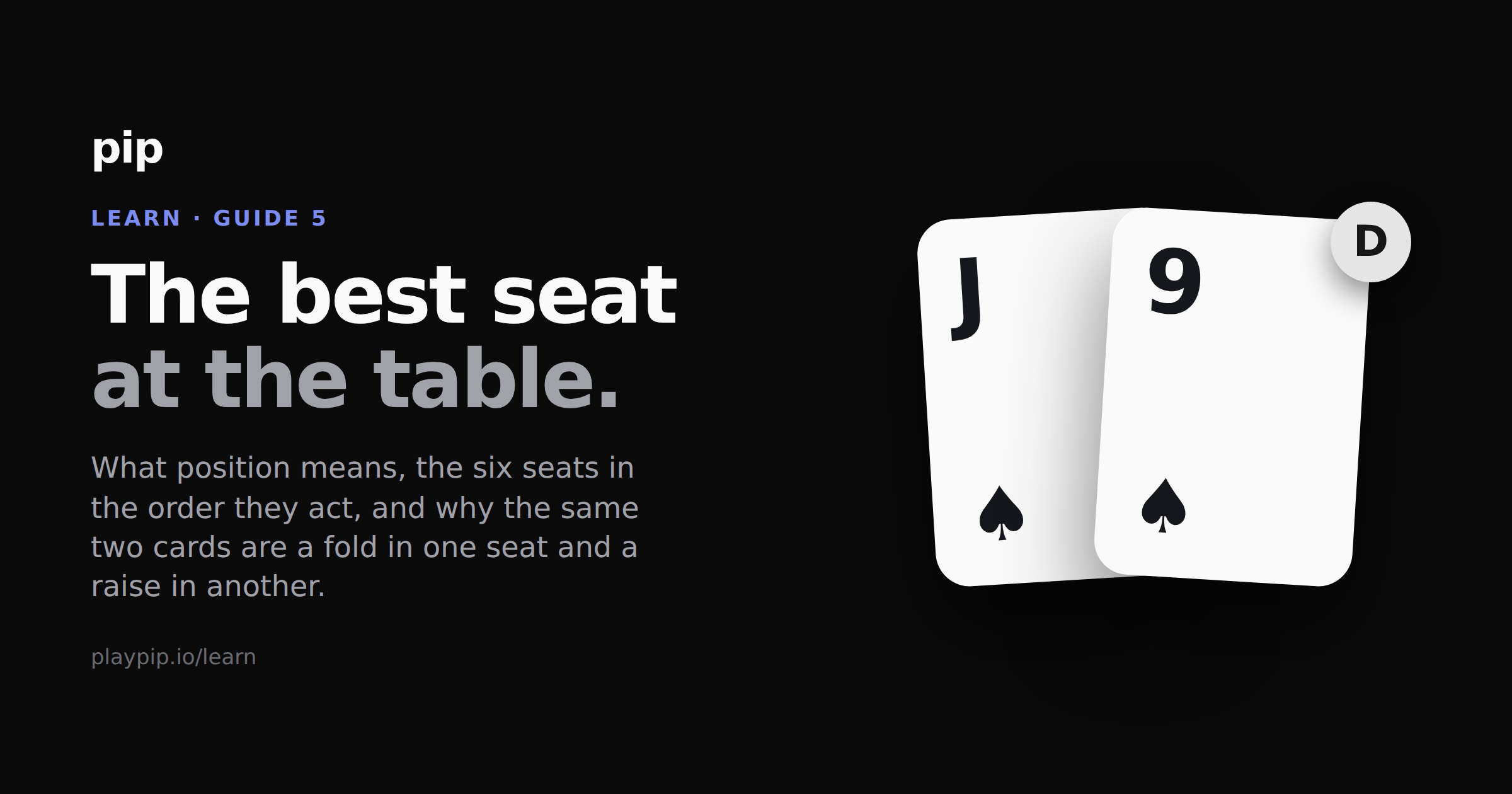
Position is where you sit in the betting order, measured from the dealer button. Acting late means you have watched everyone else act before you decide, and acting early means you have not. It is the reason the same two cards are a fold in one seat and a raise in another: from the first seat you can profitably play about 13% of hands, and from the button about 41%.
The cards did not change. Your seat did.
The seats, in the order they act
The button moves one seat to the left after every hand, so everyone gets every seat. At a six-handed table it is your button once every 6 hands.
| Seat | Before the flop | After the flop | Players still to act preflop |
|---|---|---|---|
| Under the gun | first | third | 5 |
| Middle | second | fourth | 4 |
| Cutoff | third | fifth | 3 |
| Button | fourth | last | 2 |
| Small blind | fifth | first | 1 |
| Big blind | last | second | 0 |
Two things in that table surprise people, and both are worth more than the names.
The button is not last before the flop. The blinds act after it, because they have already put money in and are owed the chance to respond. The button is last on the flop, the turn and the river, which is three streets out of four and all of the ones where the pot is big.
The blinds act last before the flop and first after it. They pay for one and then hand back the other. That trade is the whole reason the blinds are the seats where money is lost.
Who acts when
Six-handedTap a seat, then flip the toggle. The numbers are the betting order.
Button acts fourth of 6 before the flop.
- Still to act after it, preflop
- 2
- Hands it opens
- 41%
The button is fourth of six before the flop and last on every street after it. Three streets out of four, and they are the ones where the pot is big.
Why acting last is worth so much
It is not mysterious and it is not about aggression. It is that you get more information for the same money, every round, for the whole hand.
You see their decision before you make yours. From the button, three players have already told you something before the flop, and after it everyone still in the hand acts before you do, on every street. From the first seat you are guessing, and everyone behind you gets to react to your guess.
You choose whether there is a bet at all. Checked to you, you can bet. Bet into, you can fold cheaply. In early position you make that decision first and then find out whether it was a good one.
You control what the pot costs. Last to act, you decide the size of the pot on every street after the flop. First to act, someone else decides it for you. That is bet sizing, and position is what lets you use it.
And bluffs work when the other player has already given up. From last position you know they have. From first position you are hoping.
None of that is measurable as equity, which is exactly why beginners underrate it. Equity is a property of the cards, and position is a property of the information, and only one of the two shows up in a percentage on screen.
What it does to the hands you play
This is the practical version, and it comes straight from the starting-hand chart, whose bands are arranged by position for this reason.
| Seat | Hands worth opening | Roughly |
|---|---|---|
| Early | 13% | one hand in eight |
| Middle | 20% | one in five |
| Late, the cutoff or the button | 41% | two in five |
The playable set roughly triples between the first seat and the last. J9s is a fold under the gun and a routine open on the button. So is A9o, so is 87s, so is most of what sits in the middle of the chart. If you play the same hands from every seat, you are either far too tight on the button or far too loose under the gun, and it is almost always the second one.
There is a bonus you get for free. If everyone at the table plays those bands, the action folds around to the button about four times in ten. When it does, you are last to act with only two players left to get through, and quite often you win the blinds without a flop. That is not a trick, it is just what happens to whoever is sitting in the good seat.
The same hand, three seats
It folds round to youThe cards do not change between the panels. Only the seat does.
Under the gun
Fold
Middle
Raise
Button
Raise
On the chart, J9s is Middle onwards. Every seat earlier than that folds it, and nothing about the two cards is different when it does.
The other half: who is left behind you
Playing early is not only about acting first. It is that more people can still turn up with a better hand.
| Players still to act | Chance one of them has JJ+ or ace-king |
|---|---|
| 5, from under the gun | 14.4% |
| 2, from the button | 6.0% |
| 1 | 3.0% |
You are about two and a half times more likely to run into a big hand from the first seat than from the button. Same cards, same table, different number of people who can beat you. That is the second reason the early range is a third of the size, and it has nothing to do with information at all. The bottom row is exact, at 40 of the 1,326 possible hands; the other two come from dealing the table out a couple of million times, because the cards you can see are cards they cannot have.
The blinds
You post before you see cards, once an orbit, whatever you are dealt. Then you act last before the flop and first on every street after it. They are the worst seats at the table and you cannot skip them, so the useful question is only how cheaply you get through them.
The big blind is the one place you correctly play a wide range out of position. You already have money in the pot, so you are being offered a better price to continue than any other seat gets. That price is pot odds, and it is a real discount. Take it when it is genuinely cheap. It is still the worst seat, and the discount does not turn a bad hand into a good one.
The small blind is the trap. It has money in like the big blind and none of the compensation, because it acts first on every street after the flop. Being half-in is the reason people call there, and it is a reason to fold, not a reason to play.
Three mistakes worth naming
Playing a hand because it looks good, from wherever you happen to be sitting. This is the whole error and everything else is a version of it. Look at the seat before you look at the cards.
Calling from the blinds because you are already partly in. The chips you posted are not yours any more. They are in the pot, and they will not be less spent if you fold.
Forgetting about position after the flop. Once the hand starts, what matters is whether you act before or after the player doing the betting. If they are on your left, every street costs you the same guess again.
Position is the one concept on this list you cannot practise by reading, because it only exists at a table where the button moves.
You can play Texas Hold’em on Pip right now, in the browser. No account needed, nothing to install, no money involved anywhere and none to spend. Tables run from two seats up to 6, so your seat changes every hand and the whole of this page turns up several times a minute. The blinds also rise every 6 hands, which is one full orbit, so the good seat is worth a bit more each time it comes back round to you.